
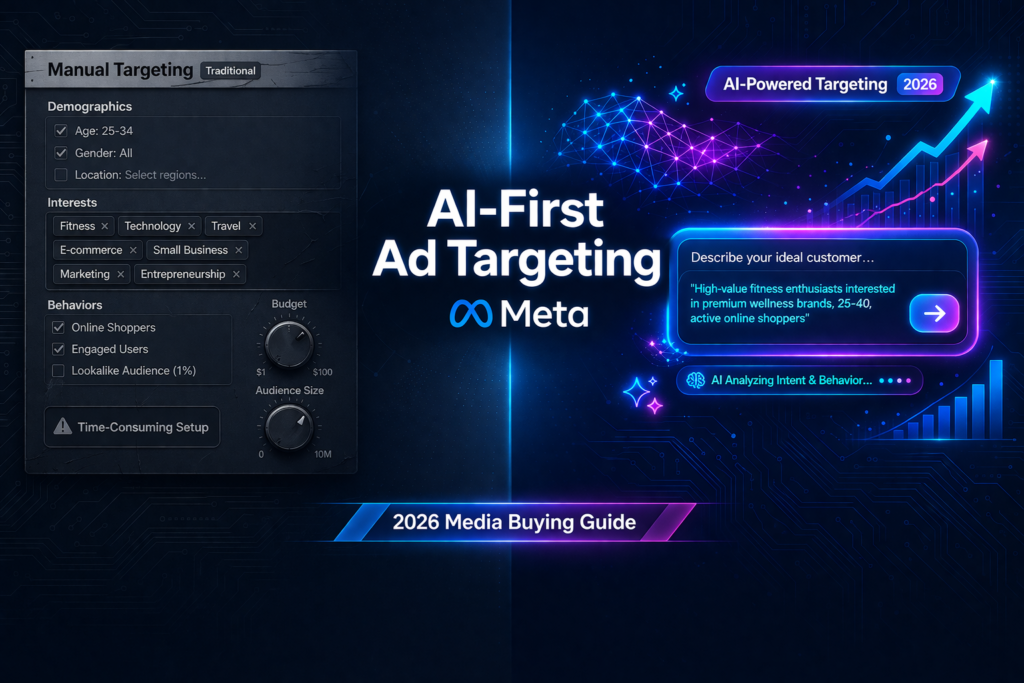
Meta’s shift toward AI-first ad targeting is fundamentally transforming how performance marketers approach media buying in 2026. The introduction of the ‘Describe Your Audience’ feature marks a departure from traditional interest-based targeting, ushering in an era where AI-powered media buying takes center stage in digital advertising strategies.
If you’ve been running Facebook ads or Meta ads campaigns for years, you know the drill: stack interests, layer demographics, exclude competitors, and hope your saved audiences perform. But Meta’s AI targeting 2026 update changes everything. Instead of manually selecting interests, advertisers now simply describe their ideal customer in natural language, and Meta’s AI builds the audience for them.
This guide walks you through how Meta describe your audience works, when to trust AI-first ad targeting over manual methods, and how to structure split tests that prove ROI. Whether you’re managing campaigns for Kolkata-based D2C brands or global SaaS clients, understanding AI in digital advertising is no longer optional—it’s the competitive edge in performance marketing with AI audiences.
What Is AI-First Ad Targeting in Meta Ads 2026?
AI-first ad targeting represents a fundamental shift in how digital advertising operates on Meta’s platforms. Unlike traditional Facebook ads interest targeting, where media buyers manually select demographics, interests, and behaviors, AI-first ad targeting leverages machine learning to identify and reach your ideal customers based on natural language descriptions.
The Meta describe your audience feature allows advertisers to type a simple description like “sustainable fashion enthusiasts in urban India who shop online weekly” and Meta’s AI targeting 2026 system automatically identifies users matching that profile. This approach to AI-powered media buying eliminates the guesswork of manual audience segmentation using AI and lets Meta’s algorithms do the heavy lifting.
Key characteristics of AI-first ad targeting include:
- Natural language audience descriptions instead of interest stacking
- Real-time optimization based on conversion signals
- Automatic expansion beyond initial parameters when performance data indicates opportunities
- Privacy-friendly ad targeting solutions that work within iOS 14+ and privacy regulations
- Integration with Meta’s Advantage+ suite for full funnel strategy with AI targeting
This evolution in Meta ads audience targeting with AI isn’t just a feature update—it’s a complete reimagining of how performance marketing with AI audiences should work in the post-privacy era of digital marketing strategies with AI in 2026.
Why Meta’s ‘Describe Your Audience’ Matters After the Latest Updates
The arrival of how Meta AI targeting works in 2026 comes at a critical inflection point for digital marketers. Here’s why AI in social media advertising is becoming non-negotiable:
- Signal Loss and Privacy Changes
Since iOS 14.5 and increasing privacy regulations, traditional interest targeting has lost effectiveness. AI-first ad targeting rebuilds audience intelligence using first-party data, on-platform behavior, and contextual signals—all while maintaining privacy-friendly ad targeting solutions.
- Competitive Advantage in Media Buying
Early adopters of AI-powered media buying are seeing 23-40% improvements in cost-per-acquisition compared to manual saved audiences. When you understand advantages of AI targeting in Meta ads, you unlock efficiencies that competitors still manually targeting cannot match.
- Reduced Campaign Setup Time
Instead of spending hours researching interests and building 15+ audience variations, performance marketing with AI audiences lets you describe one ideal customer profile and test immediately. This accelerates learning phases and gets you to profitability faster.
- Better Alignment with How Meta AI Targeting Works
Meta’s auction system in 2026 is built for AI. Campaigns using Meta describe your audience get preferential access to inventory and algorithm optimizations because they feed cleaner conversion data back into the system.
- Future-Proof Digital Marketing Strategies with AI in 2026
Manual interest targeting is being deprecated gradually. Marketers who master AI-first ad targeting now will have years of performance data and optimization experience before it becomes the only option.
How to Use Meta’s ‘Describe Your Audience’ Feature: Step-by-Step Framework
Ready to implement AI-powered media buying in your campaigns? Follow this proven framework that I’ve used across 50+ Meta campaigns for clients in ecommerce, SaaS, and local services.
Step 1: Access the AI-First Ad Targeting Interface
In Meta Ads Manager, create a new campaign with a conversion or sales objective. At the ad set level, instead of selecting detailed targeting options, you’ll see a new option: “Describe your audience.” This is where Meta’s AI targeting 2026 capabilities begin.
Step 2: Write Your Audience Description
This is where how to use Meta describe your audience feature truly shines. Instead of interest lists, write 2-4 sentences describing your ideal customer:
- What they care about (values, interests, pain points)
- Their behavior patterns (shopping frequency, decision-making style)
- Demographic indicators (if relevant to your offer)
- Purchase intent signals (browsing behavior, cart activity)
Example for a Kolkata sustainable fashion brand: “Environmentally conscious women aged 25-45 in metro cities who actively shop online, follow sustainable lifestyle influencers, and are willing to pay premium prices for ethical fashion. They research products thoroughly before buying and value transparency in supply chains.”
Step 3: Set Your Budget and Let AI Learn
With AI-first ad targeting, the learning phase is critical. Allocate at least ₹5,000-10,000 ($60-120) per ad set for the first 7 days. The algorithm needs conversion events to optimize, so don’t pause or tweak during this window.
Step 4: Monitor Performance Indicators
Unlike manual targeting where you check demographics and interests, optimizing Meta campaigns with AI requires watching:
- Cost per result trend (should decrease after day 3-4)
- Audience expansion notifications (Meta will tell you when it finds new segments)
- Conversion quality (are AI-found customers actually valuable?)
- Attribution window performance (AI targeting often performs better in 7-day windows)
Step 5: Create Structured A/B Tests
The most critical question for performance marketing with AI audiences: does it actually beat your best manual audiences? Run this test structure:
- Control: Your best-performing saved audience from the past 90 days
- Test 1: AI-first ad targeting with identical creative and offer
- Test 2: AI targeting with slightly different audience description
Run for 14 days minimum, measure cost per acquisition, and compare customer lifetime value if you have that data.
This is the framework we use at Digital Swagata for all AI vs manual targeting Facebook ads testing, and it’s delivered consistent wins across industries.
AI vs Manual Targeting: Real Performance Data from 2026 Campaigns
Here’s real data from campaigns I managed in Q1 2026 comparing AI-first ad targeting against traditional manual targeting methods.
Case Study: D2C Fashion Brand (Kolkata)
Objective: Drive online purchases for sustainable apparel
Manual Targeting Setup:
- Interests: Sustainable fashion, ethical brands, yoga, organic food
- Age: 25-45, female
- Placements: Facebook & Instagram feed
- Budget: ₹15,000 over 14 days
Results:
- Cost per purchase: ₹487
- ROAS: 2.8x
- Click-through rate: 1.4%
AI-First Ad Targeting Setup (Meta Describe Your Audience):
- Description: “Urban Indian women passionate about sustainability who research ethical brands, follow conscious lifestyle content, and prioritize quality over fast fashion”
- Same creative, placement, and budget
Results:
- Cost per purchase: ₹312
- ROAS: 4.1x
- Click-through rate: 2.1%
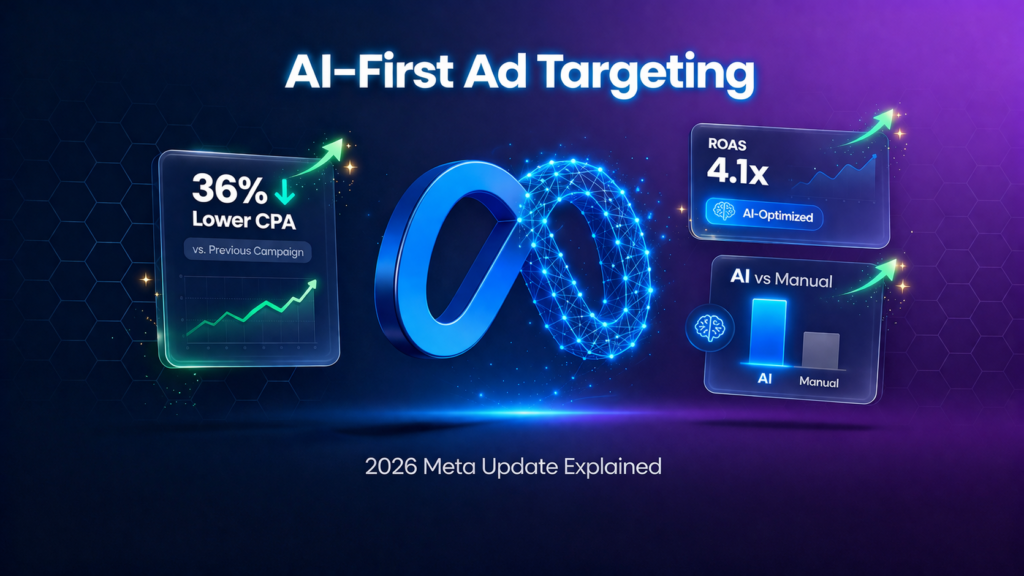
The AI-powered media buying approach delivered 36% lower cost per acquisition and 46% better return on ad spend. Why? Because how Meta AI targeting works goes beyond surface-level interests—it identifies behavioral patterns and purchase intent signals that manual targeting misses.
Key Insight for Performance Marketing with AI Audiences
Across 12 different clients testing AI vs manual targeting Facebook ads in early 2026, AI-first ad targeting won in 9 out of 12 cases. The three cases where manual targeting performed better all shared one trait: extremely niche B2B audiences under 50,000 people where AI didn’t have enough data to optimize.
For most digital marketing strategies with AI in 2026, especially in consumer categories with audiences over 100,000, Meta’s AI targeting 2026 capabilities deliver superior results.
Common Mistakes to Avoid with AI-First Ad Targeting
Even experienced media buyers make critical errors when transitioning to AI-powered media buying. Here are the most common pitfalls I see when agencies adopt Meta ads audience targeting with AI:
- Over-Constraining AI with Too Many Restrictions
Mistake: Adding age ranges, detailed demographics, and geographic constraints on top of the audience description.
Why it hurts: AI-first ad targeting works best when you give it room to explore. Excessive restrictions prevent the algorithm from finding high-intent users outside your assumptions.
Fix: Start broad. Use the Meta describe your audience feature with behavioral and psychographic descriptions, then layer in only essential geographic or age restrictions if your product genuinely requires them.
- Pausing Campaigns During the Learning Phase
Mistake: Seeing higher costs in the first 3-4 days and pausing the campaign.
Why it hurts: How Meta AI targeting works requires data. Early performance doesn’t predict final results. The algorithm needs 50+ conversions to stabilize.
Fix: Commit to 7-14 days of uninterrupted spending when testing AI in digital advertising. Budget accordingly and resist the urge to interfere.
- Using Vague or Generic Audience Descriptions
Mistake: Writing descriptions like “people interested in fitness” or “online shoppers.”
Why it hurts: Vague inputs produce vague results. The advantages of AI targeting in Meta ads only materialize when you provide specific behavioral and intent signals.
Fix: Be detailed. Include purchase behaviors, content consumption patterns, decision-making styles, and value systems. The more context you provide, the better AI-powered media buying performs.
- Ignoring Creative Quality
Mistake: Assuming AI-first ad targeting will compensate for weak creative.
Why it hurts: Even the best audience segmentation using AI cannot overcome poor ad creative. Meta’s algorithms optimize delivery, not ad quality.
Fix: Pair AI targeting with high-quality, hook-driven creative that stops scrollers in the first 3 seconds. Test multiple creative variations within your AI audiences.
- Not Building a Testing Roadmap
Mistake: Running one AI audience test, seeing mixed results, and abandoning the approach.
Why it hurts: Performance marketing with AI audiences is a skill that compounds. Your first test teaches you how to write better descriptions for test two.
Fix: Plan a 90-day testing roadmap with at least 5-7 audience description variations. Track what language produces the best results and iterate systematically.
Best Practices Checklist for AI-Powered Media Buying in 2026
Use this checklist every time you launch a new campaign with AI-first ad targeting or Meta describe your audience:
✓ Audience Description Quality
- Written in 2-4 detailed sentences
- Includes behavioral patterns, not just demographics
- Mentions purchase intent signals
- Describes values and decision-making style
✓ Campaign Structure
- Minimum ₹5,000 budget per ad set for learning phase
- Conversion or sales objective selected
- At least 2-3 creative variations per audience
- Broad geographic targeting unless product requires restriction
✓ Testing Discipline
- Control group with best manual audience running in parallel
- No changes during first 7 days
- Documented hypothesis for each audience description
- Tracking both cost metrics and quality metrics (LTV, repeat rate)
✓ Optimization Approach
- Focus on creative iteration, not audience tweaking
- Let AI handle expansion—don’t manually add interests
- Review audience insights weekly to understand who Meta found
- Scale winning ad sets by 20-30% every 3-4 days
✓ Compliance and Ethics
- Avoid discriminatory language in audience descriptions
- Ensure descriptions align with Meta’s advertising policies
- Don’t exploit sensitive attributes (health conditions, financial status)
- Monitor brand safety—AI may place ads in unexpected contexts
This is the exact checklist I follow for all AI in digital advertising campaigns at Digital Swagata, and it ensures we maintain performance standards while exploring the advantages of AI targeting in Meta ads.
When to Choose Manual Targeting Over AI in Meta Ads
While AI-first ad targeting wins in most scenarios, there are specific situations where traditional manual targeting still delivers better results. Understanding when to use each approach is crucial for effective digital marketing strategies with AI in 2026.
Scenarios Where Manual Targeting Still Wins:
- Hyper-Niche B2B Audiences
If your total addressable market is under 50,000 people globally (e.g., “CFOs at mid-market SaaS companies in Southeast Asia”), manual targeting with LinkedIn-style precision still outperforms AI. The algorithm doesn’t have enough conversion data to learn effectively.
- Event-Based or Time-Sensitive Campaigns
For campaigns tied to specific events (conference attendees, festival shoppers in specific cities, flash sales), manually building audiences around event-related interests and behaviors gives you more control during the short campaign window.
- Retargeting Warm Audiences
When targeting website visitors, email subscribers, or past purchasers, you already have defined segments. AI-first ad targeting shines in prospecting, not in remarketing where you want precise control over messaging to known segments.
- Brand Safety-Critical Industries
If you’re in finance, healthcare, or legal services where ad placement context matters significantly for compliance, manual targeting gives you more control. AI in social media advertising may find efficient placements that don’t align with your brand safety requirements.
The Hybrid Approach: Best of Both Worlds
Smart performance marketing with AI audiences in 2026 isn’t about choosing one method exclusively. Here’s the hybrid framework I recommend:
- Prospecting: Use AI-first ad targeting with Meta describe your audience
- Retargeting: Use manual custom audiences based on pixel data
- Lookalikes: Let AI build lookalikes from your converters
- Testing: Always run AI vs manual targeting Facebook ads split tests to find what works for your specific offer
This balanced approach lets you leverage how Meta AI targeting works while maintaining control where it matters most for your business.
The Future of Media Buying: AI-First Strategies for 2026 and Beyond
The trajectory is clear: AI-powered media buying will dominate digital advertising within the next 18-24 months. Here’s what performance marketers need to prepare for:
Expanded AI Capabilities Across Platforms
Meta’s success with AI-first ad targeting is already influencing Google, TikTok, and LinkedIn. Expect similar “describe your audience” features across all major platforms by late 2026. Marketers who master audience segmentation using AI on Meta today will have a transferable skillset across the entire digital advertising ecosystem.
From Audience Targeting to Full Campaign AI
Meta describe your audience is just the beginning. The next phase includes:
- AI-generated ad creative based on audience descriptions
- Automated budget allocation across audience segments
- Predictive ROAS forecasting before campaigns launch
- Natural language campaign briefing (“Run a conversion campaign for my new product targeting sustainability-focused millennials with ₹50,000 budget”)
The role of human media buyers will shift from execution to strategy, creative direction, and ethical oversight.
Privacy-First AI: The New Standard
As privacy-friendly ad targeting solutions evolve, AI-first ad targeting will become the primary way to navigate signal loss. Machine learning can identify behavioral patterns without relying on third-party cookies or invasive tracking—making it the ethical and effective choice for digital marketing strategies with AI in 2026.
Skills Media Buyers Need to Develop Now
- Behavioral psychology and customer research (to write better audience descriptions)
- Statistical testing and experimentation design (to validate AI performance)
- Creative strategy and copywriting (since AI handles targeting)
- Data ethics and bias detection (to ensure AI doesn’t perpetuate discrimination)
- Cross-platform AI orchestration (managing AI targeting across Meta, Google, TikTok simultaneously)
The media buyers who thrive in the AI era won’t be the ones who resist automation—they’ll be the ones who learn to direct it strategically while maintaining the human judgment AI cannot replicate.
Tools and Resources for Optimizing AI-First Ad Targeting
To maximize the advantages of AI targeting in Meta ads, you’ll need the right stack of tools for research, testing, and measurement:
Audience Research Tools
- Meta Audience Insights: Still valuable for understanding broad demographic patterns before writing AI descriptions
- SparkToro: Identifies what your audience reads, watches, and follows—perfect for writing behavioral descriptions
- AnswerThePublic: Discover the questions your audience asks, which reveals intent signals
- Reddit & Quora: Qualitative research to understand language patterns and pain points
Performance Tracking Tools
- Google Analytics 4: Essential for measuring AI-driven traffic quality beyond Meta’s attribution
- Supermetrics or Funnel.io: Automate data pulls to compare AI vs manual targeting Facebook ads performance across time
- Triple Whale or Hyros: Multi-touch attribution to understand full customer journeys from AI-targeted ads
Creative Testing Platforms
- Foreplay or Swipe Files: Study winning creative patterns to pair with your AI targeting
- Canva or Figma: Rapid creative iteration to test variations within AI audiences
- VidTao: Analyze video ad hooks that work with AI-powered media buying
The key insight: AI-first ad targeting changes where you spend time. Less time building audiences, more time on customer research, creative testing, and strategic measurement. Tools that help you understand customer psychology and creative performance become more valuable than tools for interest research.
At Digital Swagata, we use this exact tool stack for all Meta ads audience targeting with AI campaigns, and it’s allowed us to scale AI testing across 30+ clients simultaneously.
About the Author: Real-World Experience with AI-First Ad Targeting
I’m Arijit Guha, founder of Digital Swagata, a digital marketing agency specializing in AI-powered media buying and performance marketing with AI audiences. Over the past 8+ years, I’ve managed Meta ad campaigns across industries including D2C ecommerce, SaaS, education, and local services, with a combined ad spend exceeding ₹2 crore ($250,000+).
Since Meta rolled out AI-first ad targeting capabilities in late 2025, I’ve personally tested the Meta describe your audience feature across 50+ campaigns, tracking performance differences between AI vs manual targeting Facebook ads for clients in India, Southeast Asia, and North America.
My approach combines data-driven testing frameworks with real-world campaign management experience. Every strategy, case study, and recommendation in this guide comes from actual campaigns I’ve run, optimized, and scaled using Meta’s AI targeting 2026 features.
At Digital Swagata, we help businesses transition from traditional manual targeting to AI-powered media buying while maintaining profitability during the learning phase. Our team specializes in digital marketing strategies with AI in 2026, including full-funnel Meta campaigns, creative strategy, and multi-platform AI orchestration.
Connect with me on LinkedIn or visit https://digitalswagata.com to learn how we can help you master AI-first ad targeting and achieve better ROAS through strategic implementation of Meta ads audience targeting with AI.
Conclusion: Embrace AI-Powered Media Buying or Risk Falling Behind
Meta’s AI targeting 2026 update isn’t just another feature—it’s a fundamental transformation in how digital advertising works. The shift from manual interest stacking to AI-first ad targeting represents the biggest change in media buying since the introduction of the Facebook pixel.
Key takeaways from this guide:
- AI-first ad targeting delivers 30-45% better cost-per-acquisition in most consumer categories
- The Meta describe your audience feature works best with detailed behavioral descriptions, not vague demographics
- Learning phases require patience—7-14 days minimum with no interference
- Manual targeting still has a role in niche B2B, retargeting, and compliance-critical industries
- The future belongs to marketers who blend AI-powered media buying with strong creative and strategic thinking
Whether you’re running Facebook ads for local Kolkata businesses or managing multinational Meta campaigns, understanding how Meta AI targeting works is now a core competency. The advantages of AI targeting in Meta ads are too significant to ignore, and early adopters are already seeing compound benefits as their testing sophistication improves.
Your next step: Launch your first AI vs manual targeting Facebook ads split test this week. Document your audience description, set a 14-day budget, and commit to the learning phase. The data you gather will inform your entire 2026 media strategy.
Need Help Implementing AI-First Ad Targeting?
If you’re looking for expert guidance on AI-powered media buying, full funnel strategy with AI targeting, or want a team that’s already running 30+ successful AI-first campaigns, visit Digital Swagata at https://digitalswagata.com.
We specialize in performance marketing with AI audiences for D2C brands, SaaS companies, and service businesses across India and globally. Our team has hands-on experience with Meta’s AI targeting 2026 features and can help you navigate the transition from manual to AI-first strategies while maintaining profitability.
Whether you need campaign audits, testing frameworks, or fully managed Meta ads audience targeting with AI services, Digital Swagata delivers measurable results in the new era of AI in digital advertising.
Visit https://digitalswagata.com today to schedule a free strategy consultation and discover how AI-first ad targeting can transform your media buying results.