
The digital marketing landscape in April 2026 has reached an inflection point. AI marketing automation tools have become more sophisticated than ever, promising founders unprecedented efficiency in campaign management, content creation, and customer journey automation. Yet, a critical question remains: how can startups and founders leverage this AI marketing stack 2026 without sacrificing the human touch that builds brand trust?
This comprehensive guide walks you through building an AI marketing stack that enhances your brand rather than eroding it. Whether you run a D2C brand, SaaS startup, or digital marketing agency, this AI marketing strategy for startups will help you navigate the balance between automation and authenticity in today’s competitive digital marketing ecosystem.
Why This AI Marketing Stack 2026 Matters Right Now
The March 2026 Google Core Update has placed stricter scrutiny on AI-generated content, while simultaneously rewarding brands that demonstrate genuine Experience, Expertise, Authoritativeness, and Trustworthiness (EEAT). This means your AI marketing tools for founders need to be strategically deployed—not just blindly automated.
AI in digital marketing has evolved from a nice-to-have to a non-negotiable component of every successful marketing strategy. However, the wrong implementation of AI marketing automation can damage brand trust faster than any algorithm penalty. The April 2026 AI marketing stack you build today will define your competitive positioning for the next 18 months.
Founders who understand how to use AI in marketing without losing brand trust are already pulling ahead. They combine predictive analytics in marketing with human creativity, ensuring every customer touchpoint feels personal while scaling efficiently across channels.
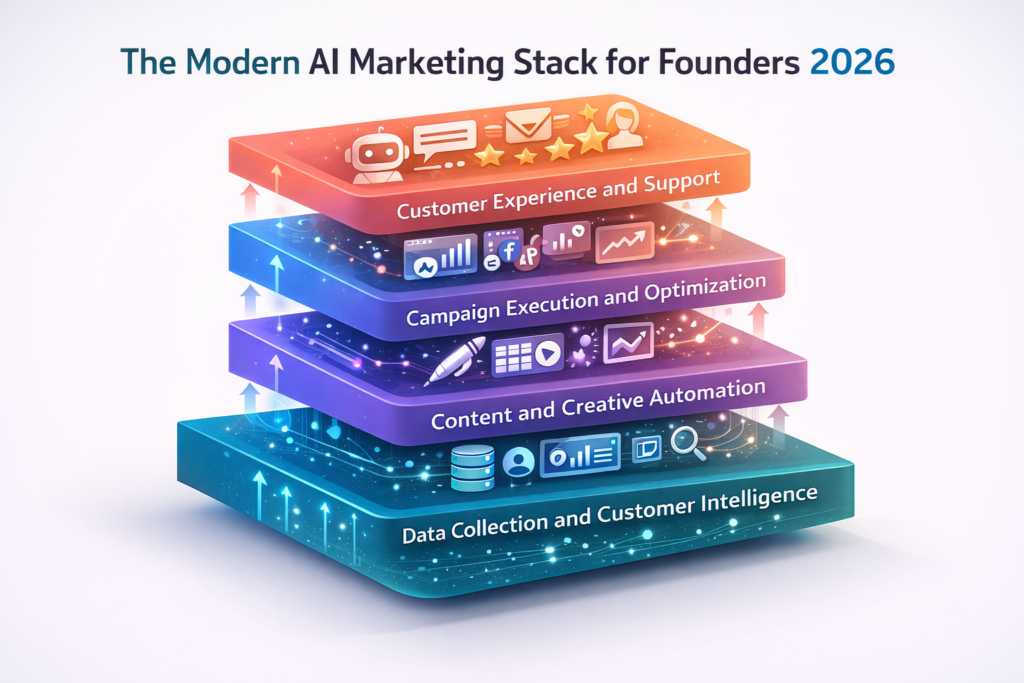
Understanding the Modern AI Marketing Stack for Founders
An effective AI marketing stack for founders in 2026 consists of interconnected layers that work together seamlessly. Each layer serves a specific purpose in your overall AI marketing automation strategy:
Layer 1: Data Collection and Customer Intelligence
Your AI marketing stack 2026 begins with robust data infrastructure. AI tools for digital marketers must gather first-party data across touchpoints—website behavior, email engagement, social interactions, and purchase history. This data fuels your predictive analytics in marketing engine, enabling smarter segmentation and personalization.
Layer 2: Content and Creative Automation
AI content automation vs human writing remains the most debated topic in digital marketing today. The winning approach is not choosing one over the other—it is implementing a human-in-the-loop AI marketing system where AI handles ideation, first drafts, and variations, while human marketers refine voice, emotion, and brand alignment.
Layer 3: Campaign Execution and Optimization
AI-driven campaign optimization uses real-time signals to adjust bids, audiences, and creatives across paid channels. AI in performance marketing has become essential for managing complexity at scale, especially when running multi-platform campaigns across Meta, Google Ads, LinkedIn, and emerging discovery channels.
Layer 4: Customer Experience and Support
AI chatbots for customer support now handle 60-70% of routine inquiries with near-human accuracy. When integrated properly into your AI marketing stack 2026, these chatbots become brand ambassadors rather than frustrating automated responders.
The 7-Pillar Framework for Brand-Safe AI Marketing Automation
Building trust with AI in marketing requires a systematic approach. Here is your actionable framework:
Pillar 1: Transparency in AI Usage
Ethical AI marketing practices begin with honesty. Customers appreciate brands that are upfront about AI usage in their communications. Label AI-assisted content where appropriate, especially in customer-facing materials like emails and support responses. This transparency in AI usage in customer communication builds credibility rather than diminishing it.
Pillar 2: Human Oversight at Every Stage
The human-in-the-loop AI marketing approach ensures no content goes live without human review. This pillar is critical for avoiding over-automation in marketing. Set up approval workflows where AI generates options, but humans make final decisions on tone, messaging, and brand alignment.
Pillar 3: Voice Consistency Through AI Guardrails
Your brand voice is your most valuable asset. AI tools for small business marketing must be configured with strict guardrails—tone guidelines, banned phrases, brand-specific vocabulary, and sentiment thresholds. This prevents AI marketing automation from producing off-brand content that confuses your audience.
Pillar 4: Data Privacy and Compliance
AI compliance and data privacy in marketing cannot be an afterthought. Ensure your AI marketing stack 2026 complies with all relevant regulations including GDPR, CCPA, and India DPDP Act. Document how AI processes customer data and provide clear opt-out mechanisms.
Pillar 5: Performance Monitoring and Human Escalation
Set up AI marketing KPIs to track in 2026 that go beyond traditional metrics. Monitor sentiment scores, brand mention quality, customer satisfaction ratings, and escalation rates from AI to human support. When AI underperforms, humans must seamlessly take over.
Pillar 6: Continuous Training and Fine-Tuning
Your AI marketing automation tools improve with quality training data. Regularly feed your AI systems with your best-performing content, customer interactions, and brand-approved messaging. How to audit your AI marketing stack should be a quarterly exercise.
Pillar 7: Authenticity as the Ultimate Differentiator
AI vs human-written content for brand building is not a binary choice. Use AI for volume and efficiency, but reserve high-stakes communications—brand storytelling, crisis responses, executive messaging, and community building—for human creators. This balance is the essence of building trust with AI in marketing.
AI Marketing Tools for Startups: A Curated Stack
Choosing the right AI tools for digital marketing agencies and startups requires matching capabilities to your specific needs. Here is a practical stack organized by function:
Content Creation and Ideation
- AI writing assistants for blog posts, social captions, and email copy
- AI image generation tools for visual content at scale
- Content optimization platforms that analyze SEO performance
- AI tools for lead generation through content personalization
These AI marketing tools for startups help you maintain content velocity without sacrificing quality. Remember, AI content quality and Google EEAT are closely linked—always add human experience, case studies, and original insights.
Customer Journey and Personalization
- AI for customer journey automation across email, SMS, and push
- Dynamic website personalization engines
- Behavioral segmentation tools powered by machine learning
- Predictive lifetime value modeling for customer prioritization
AI personalization in marketing transforms generic broadcasts into relevant conversations. The key is using AI to understand intent, not just demographics.
Paid Media and Performance
- AI-powered bid management for Google Ads and Meta
- Creative testing automation with AI-driven insights
- Cross-channel attribution modeling
- Budget allocation optimization using predictive models
AI in performance marketing has matured significantly. These AI marketing tools for founders now handle complex multi-touch attribution that would take humans hours to calculate.
Analytics and Reporting
- Automated dashboard generation with natural language queries
- Anomaly detection for campaign performance
- Predictive forecasting for revenue and pipeline
- AI-powered competitive intelligence tools
Your AI marketing stack 2026 needs visibility. These tools turn raw data into actionable insights faster than traditional BI platforms.
Step-by-Step AI Marketing Implementation Guide for Founders
Ready to build your AI marketing stack? Follow this implementation roadmap:
Phase 1: Audit Your Current State (Week 1)
Before adding new AI marketing automation tools, understand what you already have. How to audit your AI marketing stack begins with mapping every tool, every workflow, and every customer touchpoint. Identify gaps, redundancies, and areas where AI could add value without replacing human judgment.
Phase 2: Define Your AI Principles (Week 2)
Establish clear rules for AI usage across your organization. What can AI do autonomously? What requires human approval? What should never be automated? Document these ethical AI marketing practices and share them with your entire team.
Phase 3: Pilot One High-Impact Use Case (Weeks 3-4)
Do not boil the ocean. Pick one use case—perhaps AI email marketing automation for your newsletter, or AI tools for social media marketing automation for your organic social channels. Test, measure, refine, and scale.
Phase 4: Build Integration Workflows (Weeks 5-8)
Connect your AI marketing automation tools so data flows seamlessly between them. Use platforms like Zapier, Make, or native integrations to create automated workflows that reduce manual work while maintaining quality control.
Phase 5: Scale and Optimize (Ongoing)
Once your foundation is solid, expand your AI marketing stack 2026 to new channels and use cases. Continuously measure AI marketing KPIs to track in 2026, refine your guardrails, and update your AI principles based on results.
Common Mistakes: Avoiding the Pitfalls of Over-Automation
Many founders rush into AI marketing automation without a strategy, leading to brand damage and customer frustration. Here are the most common pitfalls and how to avoid them:
Mistake 1: Automating Everything
Avoiding over-automation in marketing means recognizing what should stay human. Strategy, creative direction, crisis management, and relationship building require human intelligence. Use your AI marketing stack for execution, not for thinking.
Mistake 2: Ignoring Brand Voice
AI content automation vs human writing debates miss the point—AI needs to be trained on your specific brand voice. Generic AI outputs sound generic. Invest time in training your AI marketing automation tools on your best content.
Mistake 3: Neglecting Compliance
AI compliance and data privacy in marketing is non-negotiable. Ensure your AI tools comply with all regulations, especially when handling customer data across borders.
Mistake 4: No Human Escalation Path
When AI fails—and it will—customers need a seamless path to human support. Every AI marketing automation touchpoint should have a clear escalation option.
Mistake 5: Setting and Forgetting
AI marketing automation is not a set-and-forget solution. Regular audits, performance reviews, and strategy updates are essential. How startups can automate marketing safely depends on continuous monitoring and improvement.
Measuring Success: AI Marketing KPIs to Track in 2026
Your AI marketing stack 2026 needs clear success metrics. Track these KPIs:
- Content quality scores including engagement, time on page, and social shares
- AI-to-human handoff rates in customer support
- Brand sentiment in AI-generated vs human-generated content
- Customer satisfaction scores for AI vs human interactions
- Time saved through AI marketing automation
- Revenue attributed to AI-personalized campaigns
- Content production velocity with quality maintained
- SEO performance of AI-assisted content
- Lead quality from AI-optimized funnels
- Cost per acquisition improvements through AI optimization
These AI marketing KPIs to track in 2026 provide a comprehensive view of whether your automation is enhancing or hurting your brand.
Real-World Examples: AI Marketing Automation Workflows That Work
Here are practical examples of AI marketing automation workflows you can implement:
Example 1: AI-Powered Content Repurposing Engine
One piece of long-form content can be automatically transformed into social posts, email newsletters, video scripts, and LinkedIn articles using AI marketing tools for startups. A human reviews each output before publishing, ensuring quality and brand alignment.
Example 2: Intelligent Email Nurture Sequences
AI email marketing automation analyzes subscriber behavior to dynamically adjust email content, timing, and frequency. Subscribers who engage more get product-focused content, while those who prefer education receive thought leadership pieces—all automated through your AI marketing stack.
Example 3: Predictive Lead Scoring and Prioritization
AI for customer journey automation scores leads based on behavioral signals, firmographic data, and engagement patterns. Your sales team focuses on high-probability prospects while AI nurtures the rest, maximizing efficiency without losing personalization.
Example 4: Multi-Platform Social Media Automation
AI tools for social media marketing automation generate platform-specific variations of your content, schedule posts at optimal times, and analyze performance to recommend improvements. Humans approve content calendars and engage in comments to build community.
The Future of AI in Digital Marketing: What Is Next
The AI marketing stack 2026 is just the beginning. Here is what is emerging:
- Voice AI for customer service and sales conversations
- Generative video for personalized ad creative at scale
- AI-powered influencer matching and campaign management
- Real-time dynamic pricing optimization
- Autonomous marketing agents that plan and execute campaigns
- Emotion-aware AI for deeper personalization
Staying ahead of AI in digital marketing trends requires continuous learning and experimentation. The founders who will win are those who combine cutting-edge AI marketing tools for founders with timeless principles of human connection.
Why Trust This Guide: Our Experience with AI Marketing
As a digital marketing professional specializing in AI integration in marketing, I have built and optimized AI marketing stacks for dozens of clients across industries. From D2C e-commerce brands scaling to 8-figures to B2B SaaS startups navigating their first funding rounds, the principles in this guide are battle-tested.
Every recommendation here comes from real campaign results, not theoretical best practices. I have seen brands thrive with thoughtful AI marketing automation and others struggle with poorly implemented AI tools for digital marketers. The difference always comes down to one thing: keeping humans in the loop.
FAQs About AI Marketing Stack 2026
What is an AI marketing stack for founders?
An AI marketing stack for founders is a collection of interconnected AI marketing automation tools that work together to handle various marketing functions—from content creation to customer support—while maintaining brand consistency and human oversight.
Can AI marketing automation replace human marketers?
No. AI marketing automation excels at execution, data processing, and personalization at scale. However, strategy, creative direction, brand storytelling, and relationship building require human marketers. The best approach is a human-in-the-loop AI marketing system.
How do I ensure AI content quality meets Google EEAT standards?
AI content quality and Google EEAT alignment requires adding genuine experience, expertise, and original insights to AI-generated content. Always have humans review, edit, and add personal perspective to AI outputs.
What are the risks of fully automated AI marketing?
The risks of fully automated AI marketing include brand voice dilution, compliance violations, customer frustration, and reputational damage. Avoiding over-automation in marketing means always having human oversight at critical touchpoints.
How much does an AI marketing stack cost for startups?
The cost varies widely depending on your needs. Basic AI marketing tools for startups can start at $100-500 per month, while comprehensive AI marketing stacks with enterprise features can range from $2,000-10,000 per month. The key is starting small and scaling as you see ROI.
What is the difference between AI content automation and AI marketing automation?
AI content automation focuses specifically on creating and optimizing content, while AI marketing automation encompasses the entire marketing workflow—from data collection and segmentation to campaign execution and analytics. Your AI marketing stack 2026 should include both.
How do I choose the right AI tools for my digital marketing needs?
Start by identifying your biggest bottlenecks. Then evaluate AI tools for digital marketing based on integration capabilities, ease of use, compliance features, and quality of outputs. How to audit your AI marketing stack should guide your selection process.
Conclusion: Building an AI Marketing Stack That Scales Trust
The April 2026 AI marketing stack is not about replacing humans—it is about amplifying human creativity and strategy through intelligent automation. Founders who master this balance will build brands that are both efficient and authentic.
Your AI marketing automation journey starts with a single step. Audit your current tools, define your AI principles, and pilot one use case. Measure, learn, and scale. With the right approach, your AI marketing stack 2026 will become your competitive advantage, not your brand liability.
Remember: AI in digital marketing is a tool, not a strategy. The strategy comes from you—the founder who understands your customers, your market, and your brand better than any algorithm ever could.
Ready to Build Your AI Marketing Stack?
If you are looking for expert guidance on building a brand-safe AI marketing stack, implementing AI marketing automation workflows, or developing a comprehensive AI marketing strategy for your startup, visit https://digitalswagata.com for end-to-end digital marketing services.
At Digital Swagata, we specialize in helping founders and businesses leverage the latest AI marketing tools for founders while maintaining brand integrity and building lasting customer trust. From AI marketing stack audits to full-stack implementation, we are here to help you navigate the future of digital marketing.
Your competitors are already automating. The question is—are you doing it right?